Continuous, closely-spaced vertical ridges bring texture and movement to a cabinet door — a favorite accent for modern and contemporary kitchens, whether you call it reeded or fluted.
A reeded cabinet door keeps the same framed construction as a shaker or beadboard door — stiles and rails around a center panel — but the panel itself is machined with continuous, closely-spaced vertical ridges instead of a flat or grooved surface. The repeating ridge detail catches light differently as you move past it, giving an otherwise plain door real texture and depth.
The look has deep roots in furniture and architectural millwork — reeded columns and reeded furniture legs go back centuries — and it's come back strong in modern and contemporary kitchens over the last few years, especially on islands and accent cabinetry.
Every reeded door we install is made to order for your kitchen, in your choice of finish.
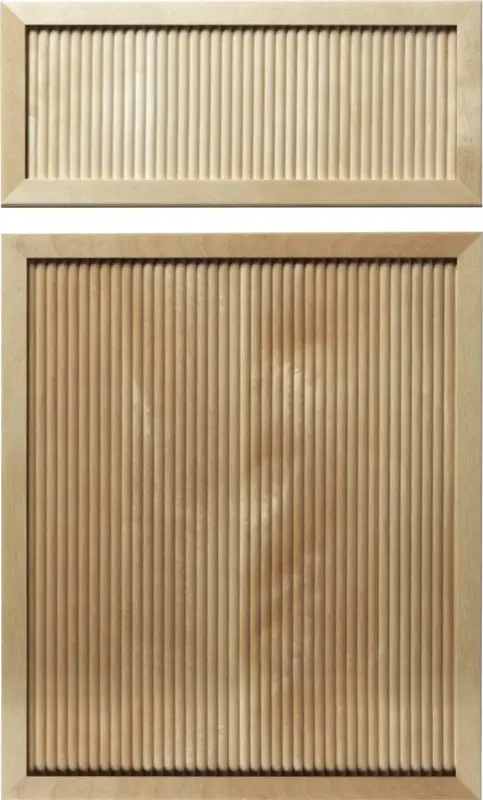
The two terms describe mirror-image profiles — but in everyday kitchen-cabinet language, they're often used to mean the same thing.
Rounded ridges stand proud of the surface, like a row of dowels laid side by side. Light catches the raised curve of each ridge.
Grooves are cut into the surface, like a row of shallow channels. Light and shadow pool inside each groove instead.
In practice, most kitchen and furniture makers — us included — use "reeded" and "fluted" interchangeably to describe this continuous ridge look. Tell us which profile you have in mind and we'll build it to match.
Every reeded or fluted door is made to order, so each of these choices is yours to mix and match.
Free consultation — we bring real door samples to your home.