What crown molding actually changes
Walk into a lot of kitchens built in the '80s and '90s, whether it's in Springfield, Wilbraham or across the line in Somers and Stafford, and you'll see the same thing: upper cabinets that stop short of the ceiling, with a strip of bare wall or a boxed-in soffit above them. It's one of the most common reasons a kitchen looks unfinished, even when the cabinets themselves are in good shape.
Crown molding is the trim that runs along the top of the upper cabinets. It ties separate cabinets together into one continuous line and carries the eye up toward the ceiling, so the cabinets look like they were built for the room instead of hung on the wall. At Homestead Cabinet Design we add cabinet crown molding and trim for homeowners across Western and Central Massachusetts and northern Connecticut, most often as part of a painting or refacing project.
The short answer: crown is worth it when there's a visible gap or a soffit above your uppers and you're already updating the cabinets. It costs less as an add-on to painting or refacing than as a standalone job. If your cabinets already reach the ceiling, you don't need it.
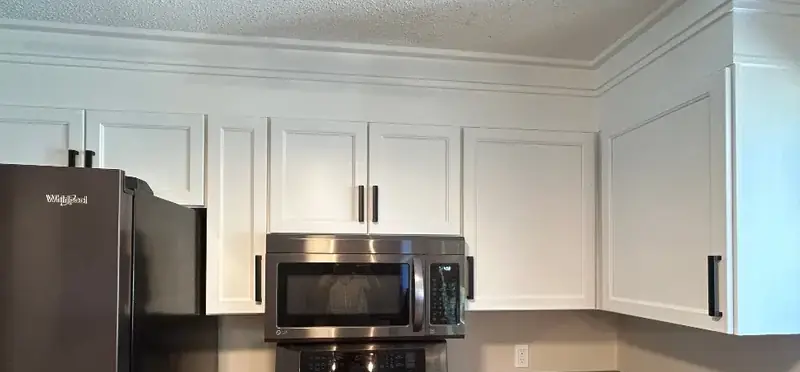
A continuous run of crown ties the tops of the uppers together into one finished line.
Crown and the trim that goes with it
Crown gets most of the attention, but it's one of several trim pieces that finish a run of cabinets. Here's what we install, all of it painted or stained to match your cabinets:
- Cabinet crown, the profiled molding along the top of the upper cabinets.
- Light rail, a smaller molding under the upper cabinets. It hides under-cabinet lighting and gives the bottom edge a finished look.
- Dentil molding, a traditional detail made of a row of small blocks.
- Scribe molding, thin trim that closes the uneven gaps where a cabinet meets a wall or ceiling that isn't perfectly straight.
- Toe kick replacement, a new finished panel along the base of the lower cabinets.
You don't need every piece. Plenty of kitchens look right with crown alone. Light rail makes the most sense if you have under-cabinet lights or plan to add them.
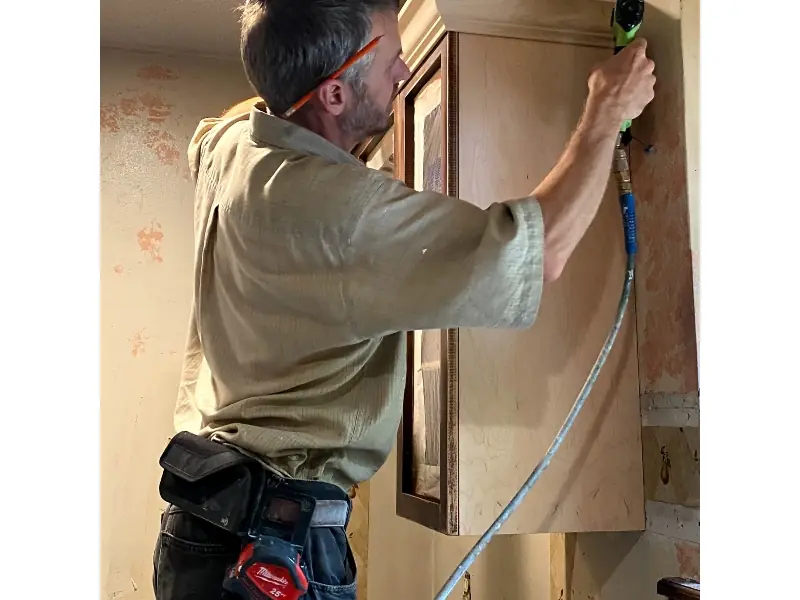
During: crown being fitted across the top of a run of uppers.
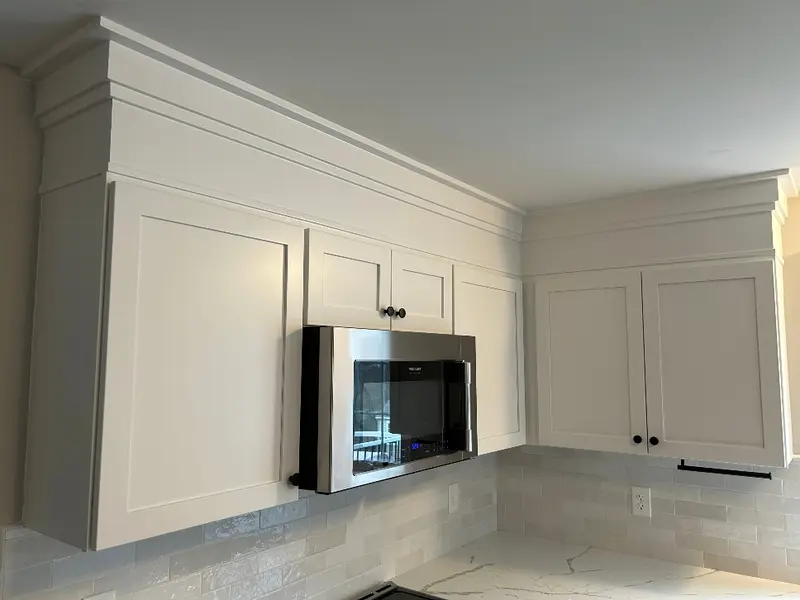
After: the top of the cabinets closed to the ceiling and finished with crown.
When crown molding is worth it
These are the situations where crown makes the biggest difference:
- There's a visible gap above the uppers. Crown finishes that top edge so the gap stops looking like an afterthought.
- You have a soffit. Crown works with soffits. It's fitted so the cabinets and the soffit read as one built-in unit.
- You're already painting or refacing. The trim gets painted or stained to match the cabinets anyway, and crown costs less as an add-on than as a separate job later.
- Your ceiling isn't level. Crown is scribed to follow the ceiling, so it hides small dips and humps instead of showing them off.
- Only some runs need it. Crown can be added to just some of the cabinets, such as the perimeter uppers but not the island.
When you can skip it
Crown isn't the right move for every kitchen. Save your money, or put it somewhere else, when:
- Your cabinets already reach the ceiling. Crown isn't needed. Light rail under the uppers may still be worth adding.
- The cabinets themselves need help first. Trim on top won't make up for cabinet boxes that are failing or water-damaged. Deal with the cabinets first, and crown can come later.
- You'd rather have the storage. If the space above your uppers is tall and the ceiling is 9 feet or more, extending the cabinets to the ceiling may be the better use of that space. It still finishes with crown at the top.
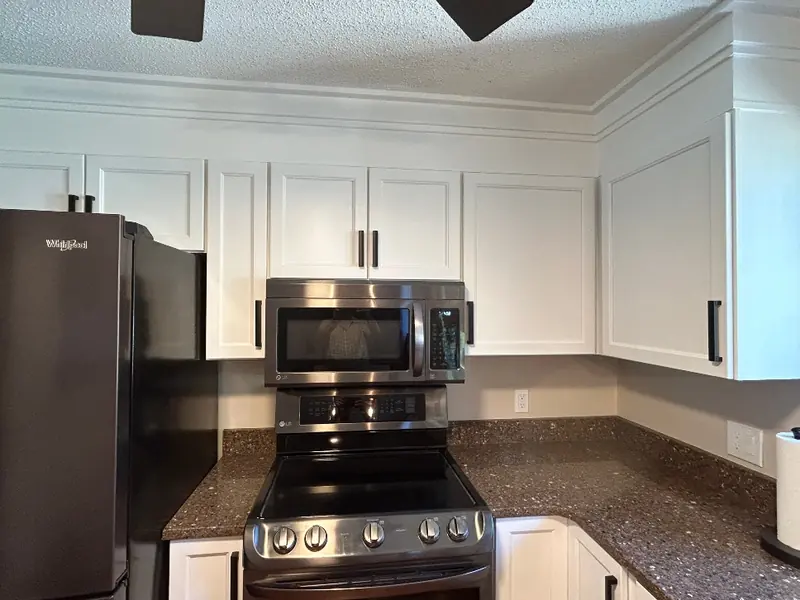
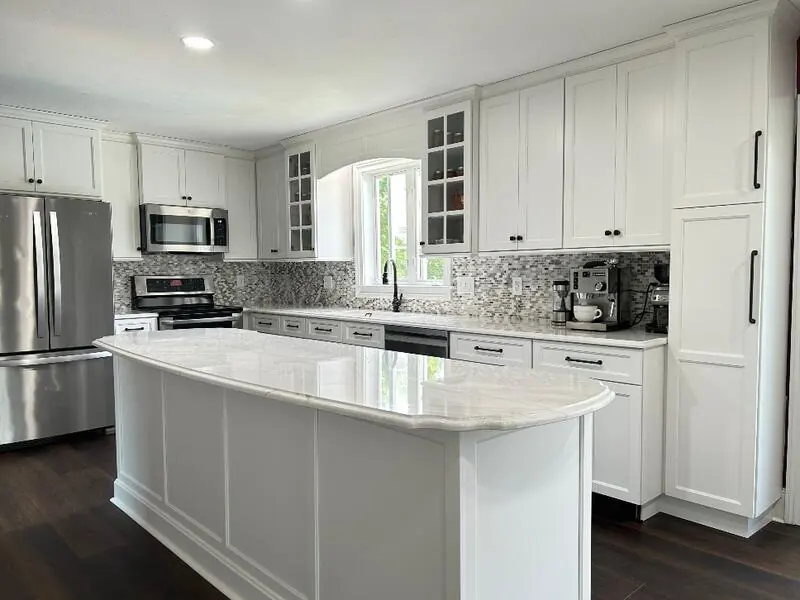
When the cabinets already run to the ceiling, crown isn't needed, though it can still finish the top edge.
Crown molding vs. extending your cabinets to the ceiling
When there's a lot of open space above the uppers, homeowners often weigh crown against extending the cabinets to the ceiling. Extending means either stacking new matched cabinets on top of the existing uppers or replacing the uppers with taller ones. Here's how the two compare:
| Crown molding | Extending to the ceiling | |
|---|---|---|
| What it does | Finishes the top of the existing uppers | Adds stacked cabinets or taller uppers, with crown at the ceiling |
| Adds storage | No | Yes, with interior shelves |
| Ceiling height | Works with any height | Best at 9 feet or more; 8-foot ceilings gain little |
| Soffits | Works with soffits | A soffit may limit the height (removing it is sometimes possible) |
| Uneven ceilings | Scribed to fit | Crown at the ceiling is scribed to fit |
| Best timing | With painting or refacing | With painting or refacing |
With 8-foot ceilings, crown is usually the better fit. With taller ceilings, it's worth looking at both. Our guide to small cabinets above kitchen cabinets goes deeper on the stacked option.
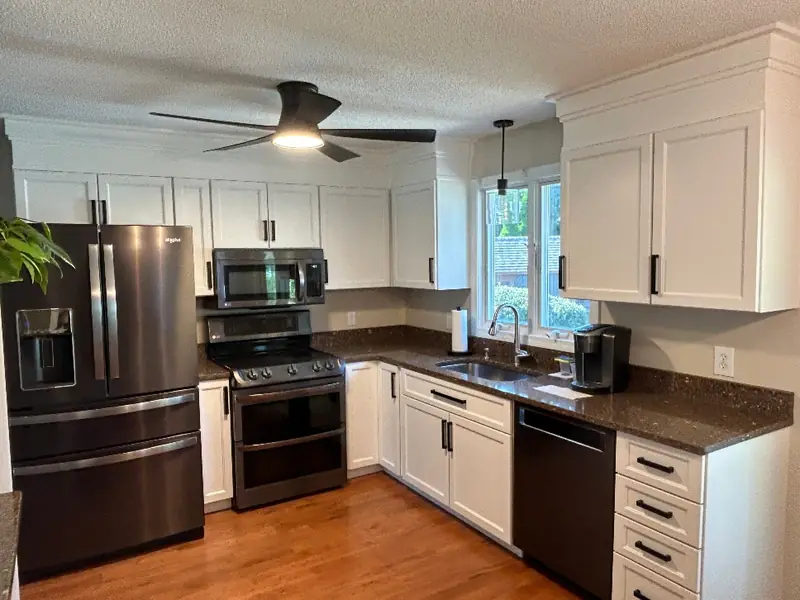
Chicopee: refaced kitchen with the uppers carried to the ceiling.
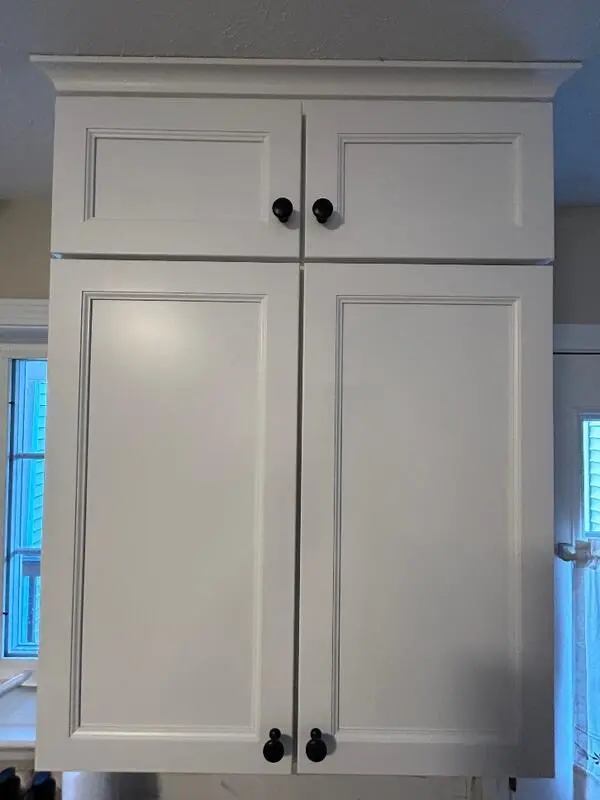
Stacked cabinets added above existing uppers, matched to the original finish.
Matching new trim to your cabinets
New molding should look like it has always been there. All crown and trim is painted or stained to match, and finishing is done in our own spray booth.
- If you're painting: the crown gets the same color as the cabinets. We can match any Benjamin Moore or Sherwin-Williams color.
- If you're keeping your current finish: Raymond takes one of your doors, cleans off the cooking film and sprays 2–4 samples on matching wood. You approve the sample in your own kitchen and lighting before anything is built. See cabinet color matching for how close each type of finish gets.
Painted finishes match essentially exactly. A stain on the same wood species gets very close. A stain on a different species is close in color but has a different grain.
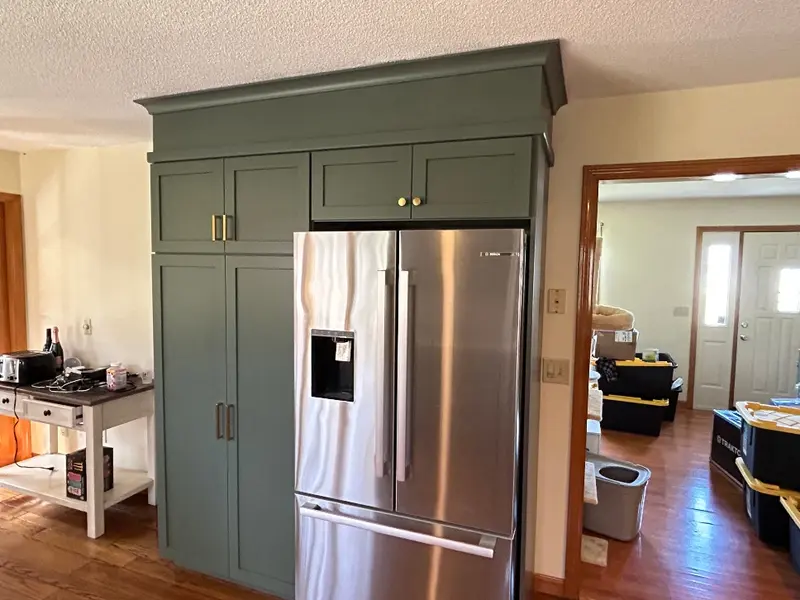
Before trim: the space above the cabinets framed and closed in.
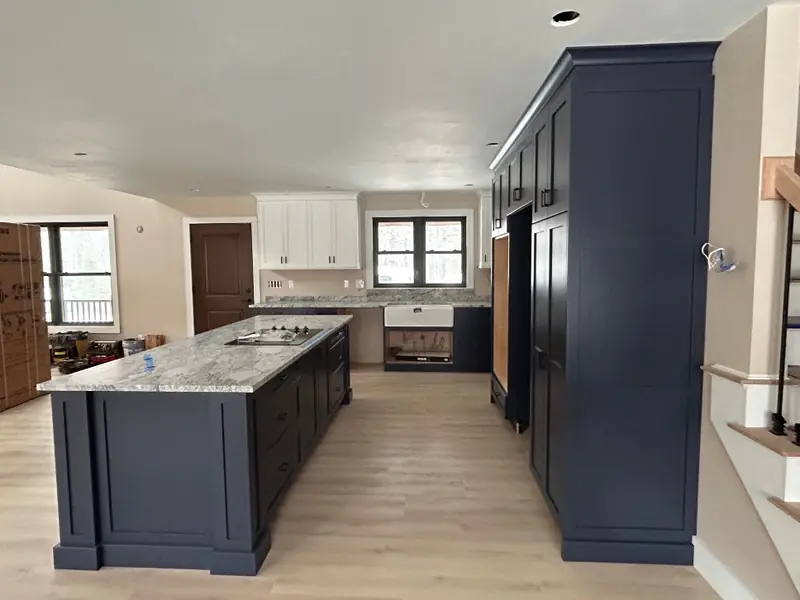
Finished: navy and white cabinets carried to the ceiling.
Adding crown during a painting or refacing project
The best time to add crown is while the cabinets are already being worked on. It costs less as an add-on to cabinet painting or cabinet refacing than as a standalone job, and the trim is finished right along with the cabinets.
If you're refacing, the top refacing level already includes new moldings and trim along with veneer on every visible surface. If you're painting, crown is a simple add to the scope. Either way, it shows up on your written proposal so you can see exactly what's included. For more ideas on bringing an older kitchen up to date without tearing it out, see how to update a 1980s or 1990s kitchen, and if you're painting, how long it takes to paint kitchen cabinets.
North Brookfield: cabinets finished all the way up to the ceiling.
Crown molding in Somers, Stafford and northern Connecticut
We're based in Palmer, and our service area runs south across the state line into northern Connecticut, including Somers, Stafford, Stafford Springs, Enfield, Suffield, Tolland, Union and Willington. If you're in one of those towns and your uppers stop short of the ceiling, crown is one of the simplest ways to make the kitchen feel finished. We also do cabinet refacing in Stafford and Enfield, which is the ideal time to add it.
Raymond is personally involved in every project, from the first visit through the final inspection. Estimates are free, and a ballpark is often possible from a few phone photos.
Frequently asked questions
Is crown molding on kitchen cabinets worth it?
Usually, if there's a visible gap or a soffit above your upper cabinets and you're already updating the cabinets. It finishes the top edge so the cabinets look built-in. It costs less as an add-on to painting or refacing than as a standalone job.
Can crown molding be added to my existing cabinets?
Yes. Crown can go on existing cabinets, and it can be added to just some runs, for example the perimeter uppers but not the island. It's most cost-effective when it's added during a painting or refacing project.
What if my ceiling isn't level?
That's normal. Cabinet crown is scribed to follow an uneven ceiling, so it fits tight instead of leaving a wavy gap along the top.
Can you add crown molding if there's a soffit above the cabinets?
Yes. Crown works with soffits. It's fitted so the cabinets and the soffit read as one finished unit.
Will the new crown match my cabinets?
Yes. All crown and trim is painted or stained to match. If you're keeping your current finish, it's color-matched from one of your doors, and you approve a sample in your own kitchen before anything is installed.
Do I need crown if my cabinets already go to the ceiling?
No. Crown isn't needed when the cabinets already reach the ceiling. Light rail under the uppers may still be worth adding, especially if you have under-cabinet lighting.
Free estimate — call or text 413-450-0028. Send a few phone photos of your upper cabinets and the space above them, and Raymond will tell you honestly whether crown molding, light rail or extending to the ceiling makes the most sense. Or request a quote online.