What thermofoil cabinet doors actually are
A thermofoil cabinet door is an MDF or engineered-wood core wrapped in a thin vinyl film. The film is heated until it softens, then vacuum-pressed down onto the face and around the edges of the door so it conforms to every profile and curve. The color or the wood-grain look you see is printed on that film. There is no real wood on the surface at all.
In the cabinet industry the same product is usually called RTF, short for rigid thermofoil. Both words describe the same construction. You'll also hear "wrapped doors," "vinyl-wrapped," or sometimes — loosely and not quite accurately — "laminate."
Thermofoil became the default for builder-grade and mid-priced kitchens starting in the 1990s for good reasons: it produces a seamless, perfectly uniform white finish with no visible joints, it costs far less than painted solid wood, and it wipes clean easily. Millions of American kitchens have it. If yours was built or remodeled between roughly 1995 and 2015 and the doors are a flawless bright white with softly rounded detail corners, thermofoil is the likely answer.
How to tell if your cabinet doors are thermofoil
You don't need any tools. Open one door and look at the back and the edges — these five checks settle it in under a minute:
- The back doesn't match the front. Thermofoil doors are wrapped on the face only. The back is a plain laminated panel, usually a flat off-white or beige, noticeably different from the front color. A solid wood door looks like the same wood on both sides.
- No end grain anywhere. Run your eye along the top and side edges. A wood door shows the cut ends of the board. A thermofoil door shows film curving smoothly over the edge with no grain crossing it.
- Detail corners are softly rounded. Because the film has to stretch into every inside corner, profile details come out gently rounded rather than crisply milled.
- Identical doors, identical grain. If yours have a printed wood look, compare two doors of the same size. Real wood never repeats; a printed film pattern does.
- A seam on the back edge. Many thermofoil doors have a faint trim line where the film wraps around and terminates on the back face.
The whole difference in one picture: thermofoil is a film on a core, so it can separate from it. A wood finish is in the surface, so it can't.
Why thermofoil cabinet doors peel
Peeling is adhesive failure — the bond between the vinyl film and the MDF core letting go. Heat is the usual culprit, and the pattern gives it away every time. When homeowners call us about lifting doors, the failures are almost always in the same handful of spots:
- Beside and above the oven or range. Radiant heat off the door and the vent every time something bakes.
- Above and beside the dishwasher. The vented steam at the end of a cycle is the single most common cause we see on drawer fronts and the door panel next to it.
- Behind a toaster oven, coffee maker, or electric kettle. Repeated localized steam and heat against an upper door.
- Around a sink. Standing water at the base of a door edge wicks into any seam.
Once the film lifts at an edge, it keeps going. The exposed MDF starts taking on moisture and swelling slightly, which pushes more film loose, and the vinyl itself shrinks a little as it releases. That's why a small lifted corner is rarely a small problem six months later.
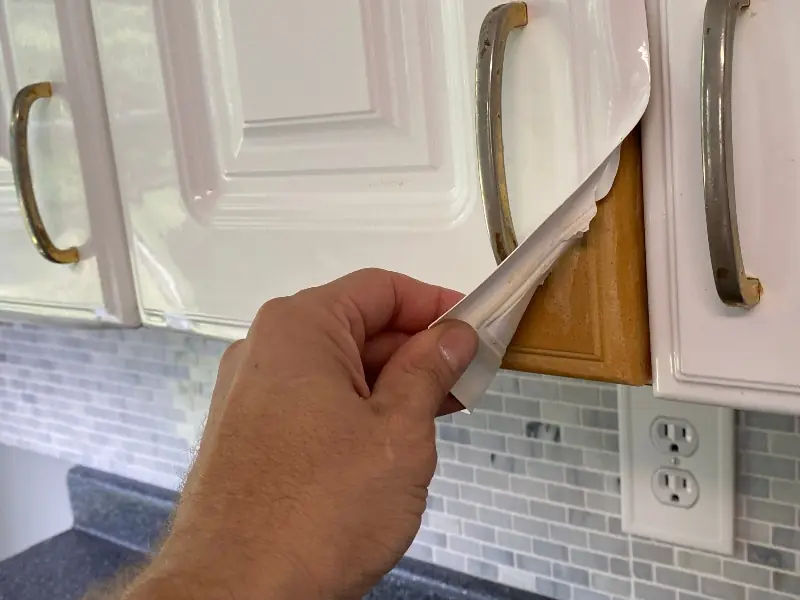
Classic thermofoil failure — the film releasing from the core along an edge. Once it starts, it spreads.
Can thermofoil cabinet doors be painted?
This is the question we get asked most, and the honest answer is that it depends on the specific doors, which is why we won't promise a result over the phone.
Thermofoil or wrapped cabinet doors require special evaluation. Some can be painted successfully; others may peel or delaminate under certain conditions. We assess this during the in-home quote rather than guessing. What we're looking at is whether the film is still fully bonded everywhere, how the surface responds to a scuff and a bonding primer, and how close the problem doors sit to the heat and steam sources listed above — because paint doesn't change any of those conditions.
Where the answer is usually clear: if the film is already lifting anywhere, paint will not reattach it. Coating over a door that's delaminating locks the problem in under a new finish, and the lifted area will telegraph through. In that situation new doors are the more reliable path, and we'll tell you so rather than sell you a paint job that won't hold.
What about refinishing or restaining? That one's a flat no. Refinishing renews a real wood surface — solid hardwood or quality wood veneer. Thermofoil has a vinyl face with no grain to work with, so there's nothing for stain to penetrate. Same answer for staining.
What actually fixes peeling thermofoil
There are three routes, and they're not equal.
Re-gluing the lifted film
You can sometimes press lifted film back down with heat and an adhesive. It's a legitimate stopgap for one drawer front you need to get through another year. But the vinyl has usually shrunk slightly as it released, so it no longer quite covers what it used to, and nothing about the heat or steam that caused the failure has changed. Expect it to come back.
Replacing just the failed doors
Workable if only one or two doors have gone and you can still source a matching door. The catch is that thermofoil ages — whites warm up over a decade — so a new door beside old ones rarely disappears. Worth asking about, especially for a rental or a short-term hold.
New doors on the existing boxes (refacing)
This is the fix most homeowners in our area end up choosing, because thermofoil doors typically sit on cabinet boxes that are still perfectly sound. Cabinet refacing replaces every door and drawer front with new made-to-order doors and re-surfaces the exposed box faces and face frames to match, keeping the existing boxes and layout. You end up with a kitchen that looks new without the cost or the demolition of a full replacement.
It also quietly solves a second problem. Wrapped doors from that era are usually partial overlay, leaving wide strips of face frame showing between doors. Refacing typically converts a kitchen to full overlay, so the doors sit close together and the kitchen reads as much more current — often the change people notice first.
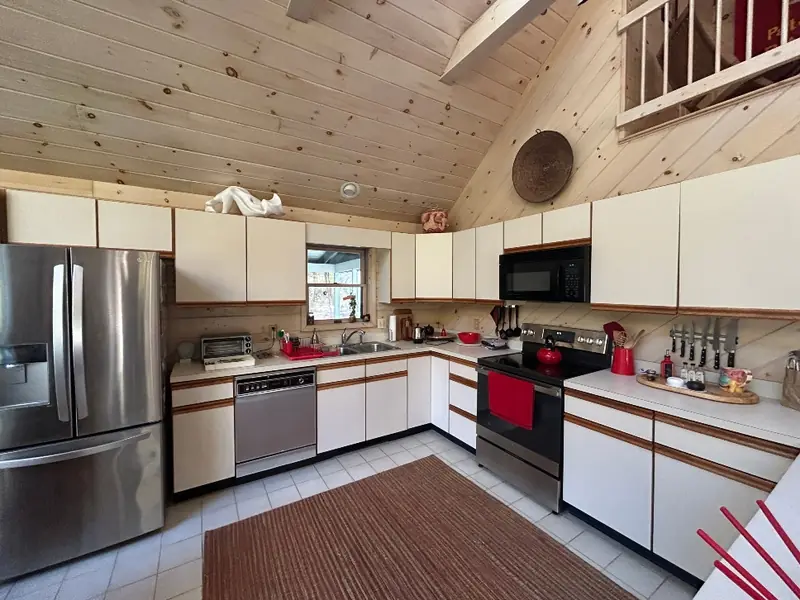
A Becket, MA kitchen with the original wrapped doors — the same surface-film construction as thermofoil, with no wood face to renew.
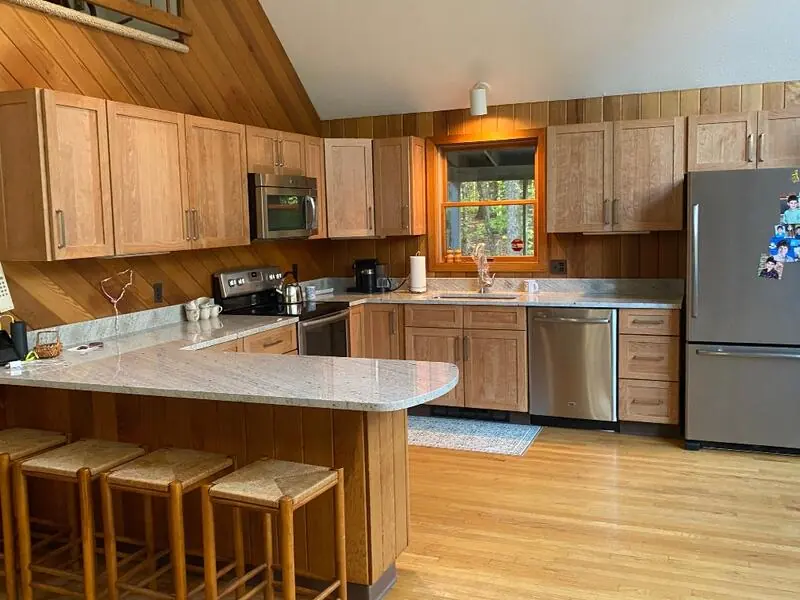
Same boxes, same layout — new cherry doors and drawer fronts with the exposed box faces re-surfaced to match.
How refacing works →Is thermofoil a bad material?
Not inherently — and it's worth separating two different things people mean by the question.
Thermofoil is still manufactured and sold today, and today's RTF is meaningfully better than the 1990s version: tougher films, better adhesives, higher heat tolerance. Modern kitchens are also built with heat shields above dishwashers, which addresses the most common failure point directly. As a material class, it's a reasonable budget choice with a genuinely seamless painted look.
We use rigid thermofoil ourselves — it's one of the standard veneer options for re-surfacing cabinet box faces during a refacing project, alongside real wood veneer and paint-grade melamine.
What's true is that a 20-year-old thermofoil door next to an oven has already told you how its adhesive is doing. If you're deciding what to put back, the tradeoff is straightforward:
| Door material | Surface | Can be repainted later? | Failure mode |
|---|---|---|---|
| Thermofoil / RTF | Vinyl film over MDF core | Case by case — needs assessment | Film peels or delaminates with heat |
| Paint-grade MDF | Painted MDF, no grain | Yes — takes paint very well | Chips or wears at edges; swells if water-damaged |
| Solid hardwood | Real wood, painted or stained | Yes — paint or refinish | Seasonal movement; finish wears over years |
| Wood veneer | Real wood over a stable core | Yes, with care | Veneer can lift at edges if soaked |
For a painted kitchen, paint-grade MDF and maple are what we're asked for most — both take a sprayed finish beautifully and, unlike thermofoil, can simply be repainted down the road. Our full breakdown is in solid wood vs. MDF cabinet doors, and every panel style is covered in the guide to cabinet door types.
Which route fits your kitchen?
Not sure what you've got? Send a photo of a door's edge and back and Raymond can usually identify the material on sight. If replacement is the right call, refacing typically runs $12,000–$22,000 depending on kitchen size, door style, and finish — and every project gets a free written quote after an in-home measure. Request a free consultation or call (413) 450-0028.
Frequently asked questions
What are thermofoil cabinet doors?
A thermofoil cabinet door is an MDF or engineered-wood core wrapped in a thin vinyl film that's heat- and vacuum-pressed onto the face and edges. The film carries the color or printed wood-grain pattern, so there's no real wood surface on the door. In the cabinet industry the same product is usually called RTF, short for rigid thermofoil.
How can I tell if my cabinet doors are thermofoil?
Open a door and look at the back and the inside edges. Thermofoil doors almost always have a plain laminated back in a different color from the front, with no end grain visible anywhere along the edges. Detail corners look softly rounded rather than crisply cut, and identical doors have identical grain patterns because the pattern is printed on film rather than cut from a board.
Why do thermofoil cabinet doors peel?
Peeling is adhesive failure between the vinyl film and the MDF core. Heat is the usual cause, which is why peeling starts on doors and drawer fronts beside the oven, above the dishwasher, or next to a toaster oven. Steam, cleaning chemicals, and simple age all contribute. Once the film lifts at an edge it keeps spreading, because the exposed core takes on moisture.
Can thermofoil cabinet doors be painted?
Thermofoil and wrapped cabinet doors require special evaluation. Some can be painted successfully and others may peel or delaminate under certain conditions, so we assess each kitchen during the in-home quote rather than promising a result sight unseen. Where film is already lifting, paint won't reattach it and new doors are the more reliable path.
Can peeling thermofoil be repaired or re-glued?
Small lifted spots can sometimes be re-adhered with heat and adhesive, but it's a short-term fix. The film has usually shrunk slightly, so it no longer covers the same area, and the condition that caused the failure hasn't changed. Homeowners who want a lasting fix generally replace the affected doors and drawer fronts.
Can thermofoil cabinets be refinished or stained?
No. Refinishing and staining only work on real wood — solid hardwood or quality wood veneer. Thermofoil has a vinyl surface with no wood grain to renew, so there's nothing for stain to work with. See our cabinet refinishing page for which materials do qualify.
What does it cost to replace thermofoil cabinet doors?
If the cabinet boxes are structurally sound, refacing replaces all doors and drawer fronts and re-surfaces the exposed box faces, typically running $12,000–$22,000 depending on kitchen size, door style, and finish. Every Homestead Cabinet Design project gets a free written quote after an in-home measure.