What “modular” and “custom” actually mean
When you start shopping for new kitchen cabinets, you run into two words over and over: modular and custom. They sound like marketing labels, but they describe two very different ways of building a kitchen.
Modular cabinets are built ahead of time in a set range of standard sizes. A modular base cabinet, wall cabinet or pantry unit comes in fixed widths and heights, and a kitchen is put together by lining those boxes up and closing the leftover gaps with filler strips. Many “prefab modular kitchen” packages and pre-made kitchen islands are built this way.
Custom cabinets are built for one kitchen: yours. Every box is sized to the wall it goes on, and the door style, wood and finish are chosen for that room. At Homestead Cabinet Design, our custom cabinetry covers full kitchens, islands, pantries and built-ins for homeowners across Western and Central Massachusetts and northern Connecticut.
Neither is automatically better. Modular cabinets have a real place, and plenty of kitchens in Palmer, Ludlow and Wilbraham are built with them. This guide lays out the trade-offs.
The short answer: modular cabinets are built in standard sizes and are usually the less expensive, quicker route. Custom cabinets are built to fit your exact space, with more choice in materials, door styles and finishes, and they cost more. If your current cabinet boxes are still solid, you may not need either one. Refacing or painting is often the better value.
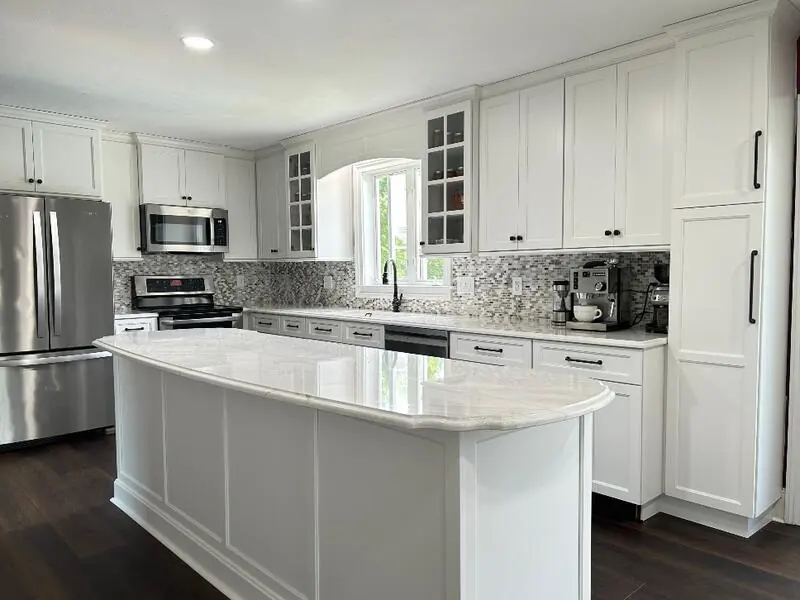
North Brookfield: custom cabinets sized to the room and carried all the way to the ceiling.
How the cabinet boxes are built
The box is the part you don’t look at every day, and it’s where cabinets differ the most. Modular cabinet lines vary a lot. Some use plywood, but many budget lines use particleboard for the sides, bottoms and backs. Particleboard is fine when it stays dry, but it doesn’t hold up well to water. A slow leak under a sink can swell it and break down the edges.
Our custom cabinet boxes are plywood, ½″ or ¾″, not particleboard. Soft-close hinges and drawer glides are standard, not an upgrade.
When you’re comparing any two quotes, modular or custom, ask these questions:
- What are the box sides, bottom and back made of?
- Are soft-close hinges and drawer glides included, or extra?
- What are the drawer boxes made of, and how are the corners joined?
- Who installs the cabinets, and is installation on the quote?
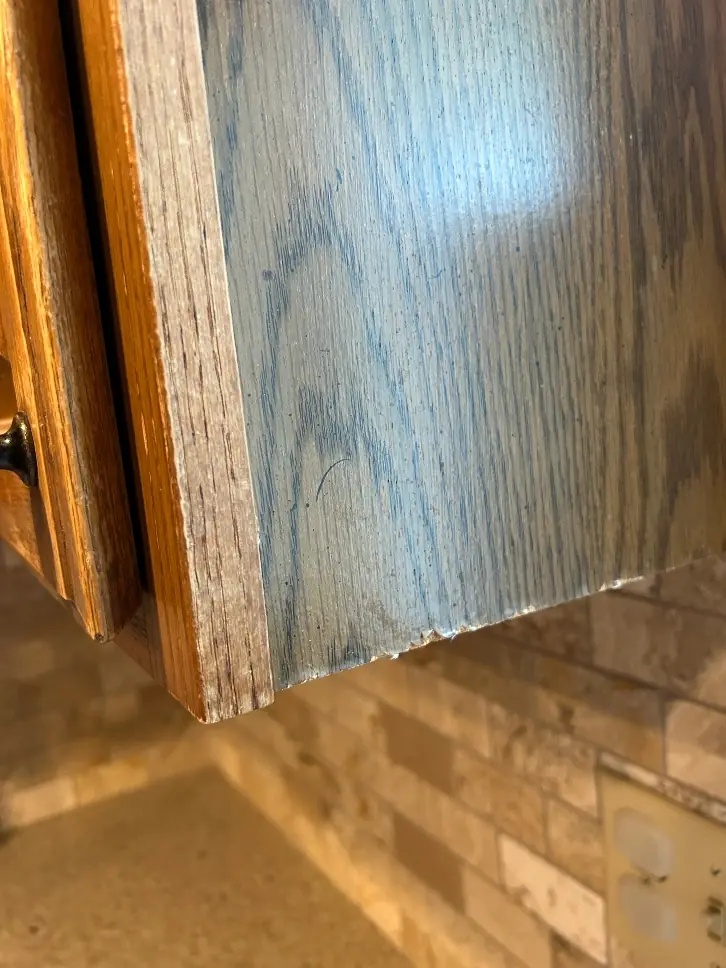
Particleboard that took on water: the sides swell and the edges break down.
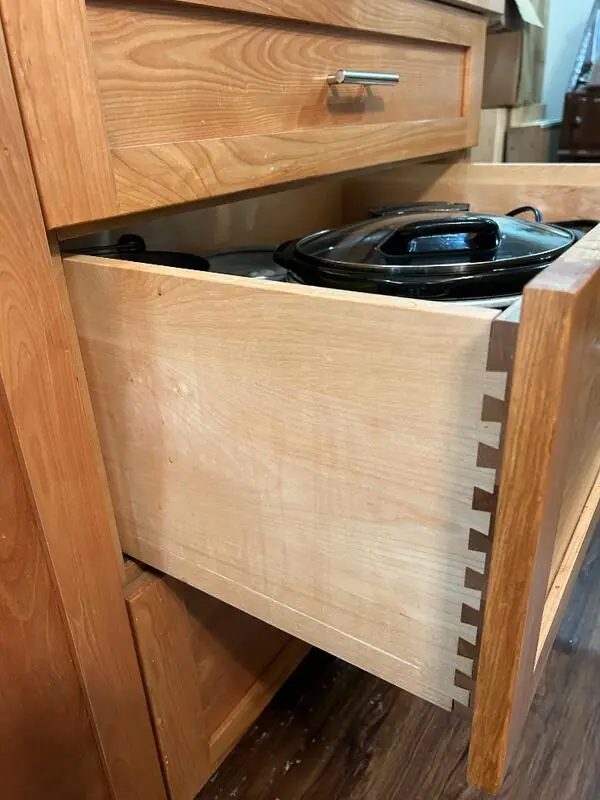
Drawers take the most abuse in a kitchen. Ask what they’re made of.
Fit: standard sizes vs. built to your room
Modular cabinets come in set widths. If your wall is a few inches longer than the boxes that fit on it, the difference gets filled with a filler strip. A filler here and there is normal. Several of them, plus a cabinet that’s narrower than you wanted, is where a modular kitchen starts to lose storage and look “assembled.”
Older homes make this harder. A lot of houses in Western Mass and northern Connecticut have walls that aren’t square, ceilings that aren’t level and odd spaces around chimneys and windows. Custom cabinets are sized to the space you actually have, so:
- Runs can fill the wall without a stack of fillers.
- Upper cabinets can be built taller to reach the ceiling, with crown at the top.
- Awkward spots, like a nook beside the refrigerator, can become a pantry cabinet with pull-outs instead of dead space.
- Cabinets can be designed around windows, outlets and trim.

A closet turned into a built-in pantry. Odd spaces are where custom sizing pays off.
Door styles, wood and finishes
With modular cabinets, you choose from the door styles and finishes that line offers. A short menu makes decisions easier, but a particular wood or exact paint color may not be on it.
With our custom cabinetry, the choices look like this:
- Door styles: Shaker, raised panel, slab or inset.
- Wood species: white oak, red birch, maple and cherry.
- Finishes: painted, stained or clear, spray-applied. Finishing is done in our own spray booth.
- Details: crown, trim, glass doors and custom interiors.
Painted cabinets can be any Benjamin Moore or Sherwin-Williams color, and two-tone kitchens and island accent colors are available.
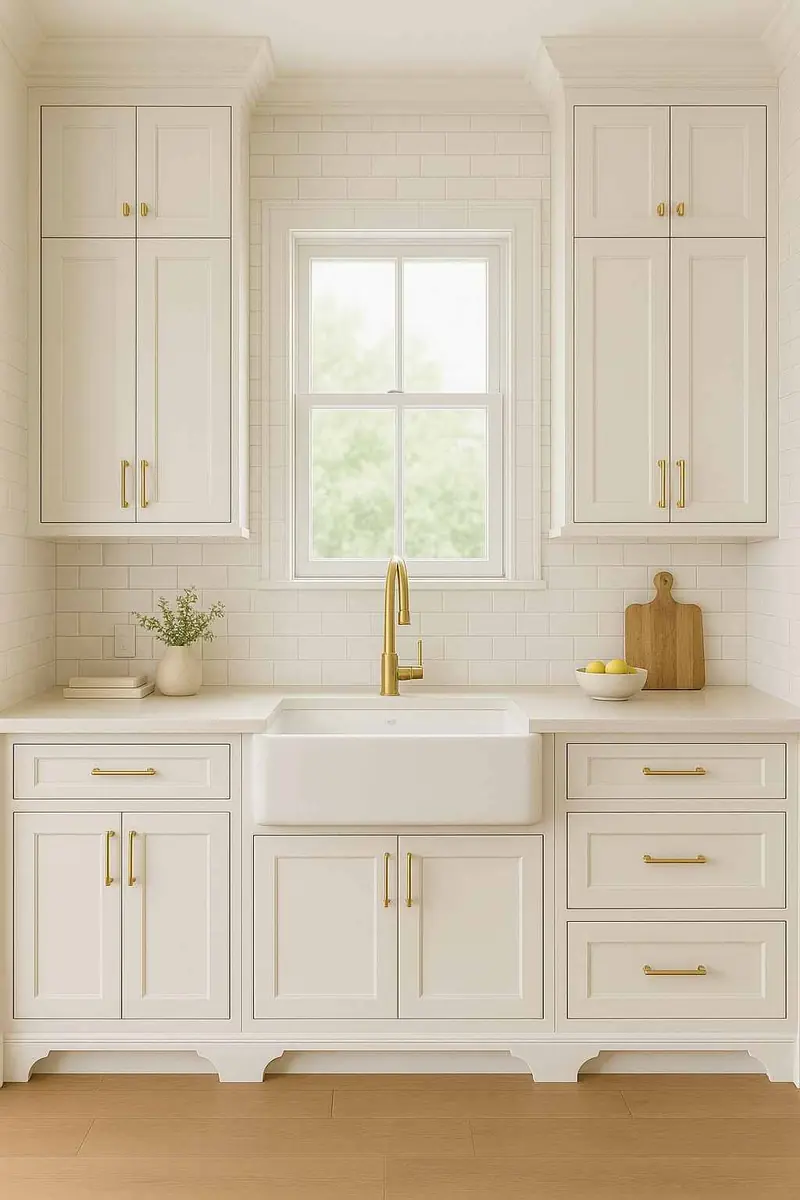
Inset doors sit flush inside the frame, a classic custom detail.
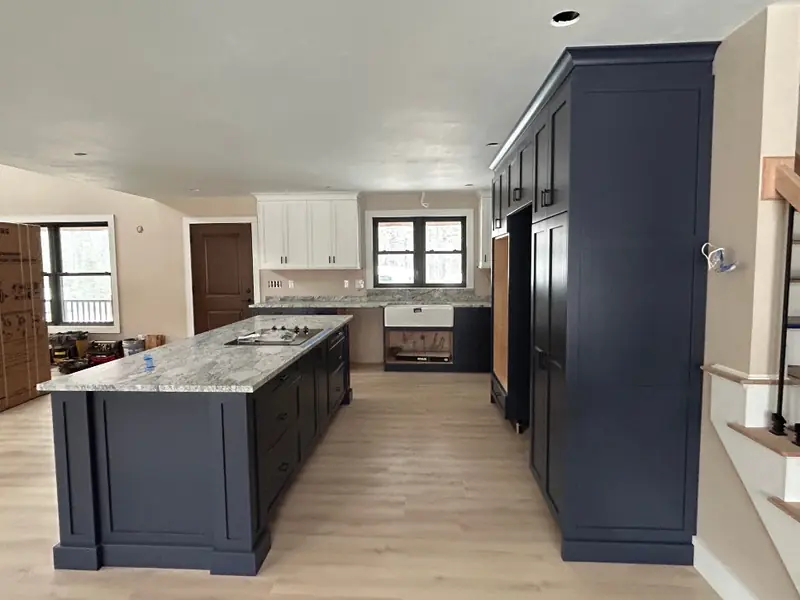
Two colors, chosen for this kitchen: navy and white running to the ceiling.
Pre-made kitchen islands vs. a custom island
A lot of people search for pre-made kitchen islands, and they can work. Most are a few standard base cabinets joined together with panels on the ends and a countertop on top. If you have a large room and want simple storage, one may do the job.
A custom kitchen island is built around how you use the kitchen. It can include drawers, doors, pull-outs, a trash pull-out, wine racks or spice storage, with a seating overhang for 2–4 stools. It can match your cabinets or contrast with them. Navy, forest green and charcoal are popular island colors.
Whichever way you go, check the space first. You need at least 42 inches of clearance on all sides, and 48 inches is better. Most islands are at least 4 feet wide, and the practical minimum is about 3 feet by 2 feet. Our page on kitchen islands with seating covers the layout in more detail.

A natural white oak island built for this kitchen.

A smaller island sized to fit, with clearance on every side.
Cost and timeline
Modular cabinets usually cost less up front, and that’s their biggest advantage. Custom cabinetry costs more because every box is built to order for your space, with the materials and finish you choose. The honest way to compare is a written quote for your kitchen, not a price per cabinet from a catalog.
Timeline matters too. With custom work, the lead time to get on our schedule is usually 3–6 months from accepting a quote. Once the cabinets are ready, on-site installation takes 1–3 weeks, and the kitchen is a full work zone during that time. For a full replacement, the cabinetry takes up to about 3 weeks, and everything else, like countertops and flooring, up to about 8 weeks in total.
One more thing to know before you buy: we only install cabinets that we build or supply ourselves. If you buy modular cabinets from a store or online, you’ll need to line up the installation separately.
Custom vs. modular at a glance
| Modular cabinets | Custom cabinets | |
|---|---|---|
| Sizes | Set standard sizes, gaps closed with fillers | Built to fit your exact space |
| Box material | Varies by line; many budget lines use particleboard | Plywood, ½″ or ¾″ (ours) |
| Door styles & finishes | The menu that line offers | Shaker, raised panel, slab or inset; painted, stained or clear |
| Odd spaces & old houses | Harder to fit cleanly | Designed around windows, outlets and trim |
| Up-front cost | Usually lower | Higher |
| Best for | Simple layouts, tighter budgets | Kitchens you plan to keep for a long time, odd layouts |
Which one fits your kitchen?
Modular is a reasonable choice when:
- Your layout is simple, with straight walls and standard ceiling heights.
- Budget is the top priority and you’re comfortable with a few fillers.
- The kitchen is a rental, or you plan to move in a few years.
Custom is worth it when:
- You plan to stay, and you want the boxes, drawers and finish to last.
- The room is an odd shape, or you want cabinets to the ceiling.
- You want a specific wood, door style or color.
- You’re adding to an existing kitchen and the new cabinets need to match.

North Brookfield: new cabinets added to an existing kitchen and finished to match.
Do you need new cabinets at all?
Before you replace anything, look at the boxes you already have. If they’re solid, with no rot or water damage, and the layout already works, full replacement may be more than you need:
- If you only want a new color, cabinet painting is the most affordable option.
- If you want new doors and a new look on the same boxes, cabinet refacing is usually the better value. Countertops and plumbing stay put.
- If you need just one more cabinet, like a tall pantry, we can add a single new cabinet built and finished to match the ones you have. See color matching for how that works.
- Kitchen desk nooks are a common one. We often remove the old desk and replace it with standard-height cabinets that match the rest of the kitchen.
Our guide to refacing vs. replacing cabinets walks through that decision, and solid wood vs. MDF doors helps if you’re choosing door materials. If storage is the real problem, start with small kitchen storage ideas.

The right answer starts with the cabinets you already have.
Frequently asked questions
What is the difference between custom and modular kitchen cabinets?
Modular cabinets are built ahead of time in standard sizes and combined to fill a kitchen, with filler strips closing the gaps. Custom cabinets are built for one kitchen, sized to the exact space, with the wood, door style and finish chosen for that room.
Are modular cabinets cheaper than custom cabinets?
Usually, yes. Modular cabinets typically cost less up front. Custom cabinets cost more because they are built to order for your space. The best way to compare is a written quote for your own kitchen.
What are your custom cabinet boxes made of?
Our custom cabinet boxes are plywood, ½ inch or ¾ inch, not particleboard. Soft-close hinges and drawer glides are standard.
Will you install modular cabinets I bought myself?
No. We only install cabinets we build or supply ourselves. We don’t install cabinets purchased from a store or online.
How long does a custom kitchen take?
The lead time to get on the schedule is usually 3–6 months from accepting a quote. On-site installation takes 1–3 weeks. For a full replacement, the cabinetry takes up to about 3 weeks, and everything else, like countertops and flooring, up to about 8 weeks in total.
Can you add one custom cabinet to my existing kitchen?
Yes. We can add a new cabinet, such as a tall pantry cabinet, to an existing kitchen, built and finished to match your current cabinets.
Free estimate — call or text 413-450-0028. Send a few phone photos of your kitchen and tell us what you’re weighing, and Raymond will tell you honestly whether custom cabinetry, refacing or painting fits your kitchen best. Or request a quote online.