The short answer
That's for professionally spray-painting an existing kitchen in two colors — most often light uppers with darker lowers, or a painted perimeter with a contrasting island. It runs a little above single-color painting ($4,900–$9,900) and well below refacing. Kitchen size, door count, an island, and oak grain are what move the number.
Two-tone kitchen cabinets have been the most-requested color update we get asked about for several years running, here in Western and Central Massachusetts and across the line in northern Connecticut. The appeal is easy to see: one color on its own can feel flat, and two colors give a kitchen some depth without tearing anything out.
The catch is that two-tone is easier to get wrong than a single color. Pick two shades that fight each other, or put the color break in an awkward spot, and the kitchen looks busier instead of better. This guide covers what two-tone cabinets cost, which combinations hold up, and the handful of rules that keep the result looking intentional.
What "two-tone" actually means
When people say two-tone, they usually mean one of three layouts:
- Upper and lower split. Wall cabinets in a lighter color, base cabinets in a deeper one. The color change happens at the countertop line, so the counter itself becomes the dividing stripe.
- Contrasting island. The perimeter cabinets stay one color and the island or peninsula gets the accent. This is the most common way to do it and the safest, because the accent sits in one block in the middle of the room.
- Three colors. Light uppers, darker lowers, and an island in a third accent color — often picked up from the countertop veining or the backsplash tile.
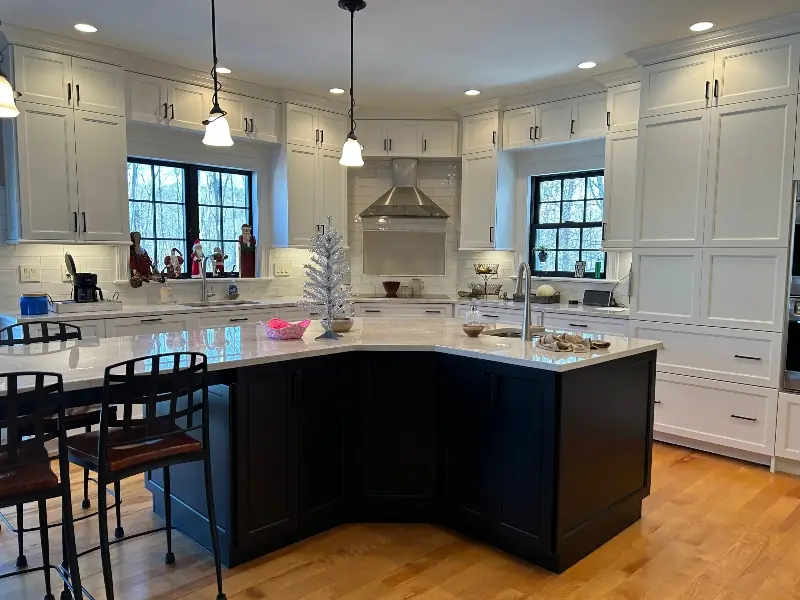
The classic contrasting island. The navy anchors the middle of the room while the white keeps the walls bright.
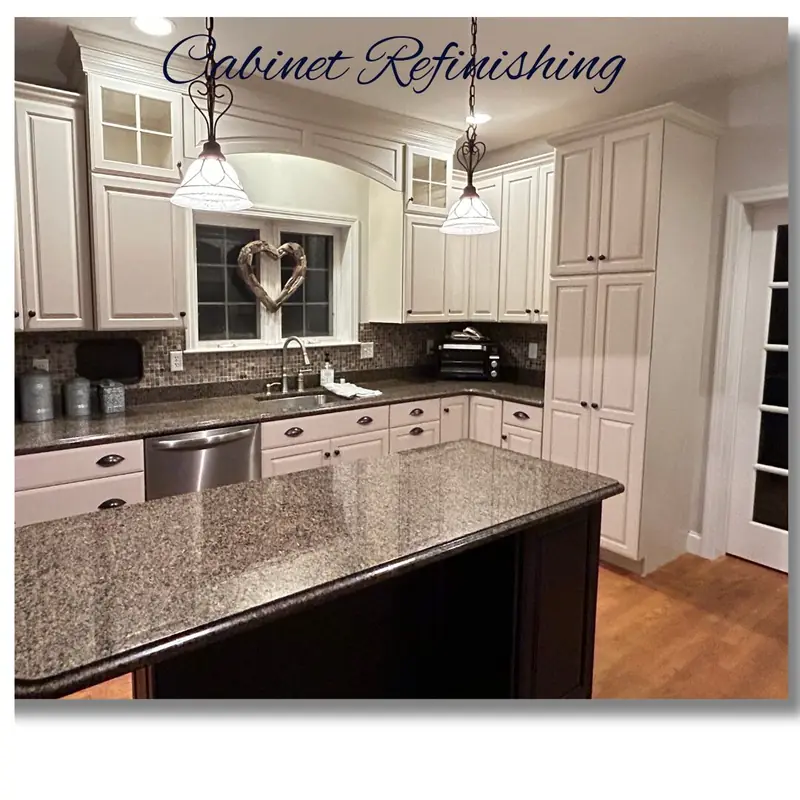
A deeper island color gives an open-plan kitchen a clear center without darkening the whole room.
What two-tone kitchen cabinets cost in Massachusetts
A two-tone project is a cabinet painting project with careful color management between zones. The prep, the spray finish, and the rehanging are the same as a one-color job. The extra cost comes from the second (or third) color: separate primer and color batches, extra masking where two colors meet on the cabinet boxes, and keeping every door sorted by color through the spray booth.
| Option | Typical range | What you get |
|---|---|---|
| Single-color painting | $4,900–$9,900 | Existing doors and boxes spray-finished in one color |
| Two-tone painting | $5,500–$11,000 | Same process, two colors split by zone, island accent available |
| Refacing (any finish, including two-tone) | $10,000–$29,000 | New made-to-order doors and drawer fronts, new veneer on the boxes |
Where your kitchen lands inside that two-tone range comes down to a few things:
Every door and drawer front is removed, prepped, and sprayed on both sides. A 20–30 door kitchen is typical; more doors means more time.
Adding an island in its own accent color makes it a three-color job. Usually worth it — it's the move people notice first.
Oak's open grain needs grain filler, extra sanding, and extra primer to paint smooth. Budget an additional $500–$1,500 for oak.
Tall pantry columns, glass doors, open shelving, and a soft-close hinge upgrade (which we recommend while the doors are off) all factor in.
The full breakdown of what goes into a painting price lives on our cabinet painting page, and the two-tone cabinets page walks through the project scope.
Color combinations that work
The combinations that hold up best follow one simple idea: one color does the quiet work and the other does the talking. In practice, the most-requested pairings in our area are:
- White or off-white uppers with navy lowers. Crisp, a little nautical, and it works with almost any countertop.
- White uppers with sage or forest green lowers. Green has been the strongest trend of the last few years and it suits older New England homes — capes, colonials, farmhouses — especially well.
- Warm cream uppers with a muted forest green. Softer than bright white. A good choice if your floors or counters lean warm.
- White uppers with charcoal lowers. The most modern-looking of the group, and forgiving of scuffs at kick height.
The colors don't exist in a vacuum, though. Your countertops, floors, and backsplash are usually staying, so the cabinet colors have to agree with them. A cool navy next to a warm, yellow-toned granite can look off; a muted green next to the same granite often looks like it was planned. This is why we bring physical samples to the in-home visit — a two-inch chip on a phone screen tells you very little about how a color reads under your lights. For more color ideas, see our best kitchen cabinet colors guide and the cabinet colors page.
Light matters more than you'd think. A north-facing New England kitchen in January sees a lot of gray light. Deep colors read darker than the sample, and stark whites can look cold. If your kitchen doesn't get much sun, lean toward a warmer white and test your dark color in the evening, not just at noon.
Rules of thumb that keep two-tone from looking busy
- Dark goes low. Darker colors on the base cabinets ground the room; light uppers keep it open. Flipping it — dark uppers over light bases — makes most kitchens feel top-heavy and smaller.
- Let the countertop be the break. The cleanest split is at the counter line. Splitting colors in the middle of a run of base cabinets almost always looks like a mistake.
- Decide where tall cabinets belong. A floor-to-ceiling pantry or oven column touches both zones. Usually it takes the upper (lighter) color so it doesn't become a dark wall; on a large island wall it can take the lower color to read as one block. Decide this up front.
- Keep to two colors plus wood or metal. A third paint color is fine when it's the island. Beyond that, let hardware, a butcher-block top, or open wood shelves add interest instead of more paint.
- Coordinate the hardware. One hardware finish across both colors ties the kitchen together. Brushed brass and matte black both work well with navy and green. New pulls and knobs are an easy add while the doors are off — see cabinet hardware.
How a two-tone painting project runs
From the homeowner's side, a two-tone job looks almost exactly like a one-color one. Plan on about 5–9 days on-site, with the kitchen usable in between.
- Color consultation. We settle the colors and the split — including the tall cabinets and the island — before anything gets sanded.
- Prep. Every surface is degreased, sanded, and primed. Oak gets grain filler. Prep is what makes the paint last.
- Doors off-site. Doors and drawer fronts come off, get labeled by location and color, and are spray-finished in the shop.
- Boxes in place. The cabinet boxes are masked and sprayed in the kitchen — uppers in one color, lowers in the other, with a clean line at the counter and the undersides of the uppers finished properly.
- Finish coat. Everything gets an ultra-durable 2K polyurethane topcoat, so the darker base cabinets stand up to kicks, mops, and dog bowls.
- Rehang and adjust. Doors go back up, hinges get adjusted so the reveals line up, and hardware goes back on.
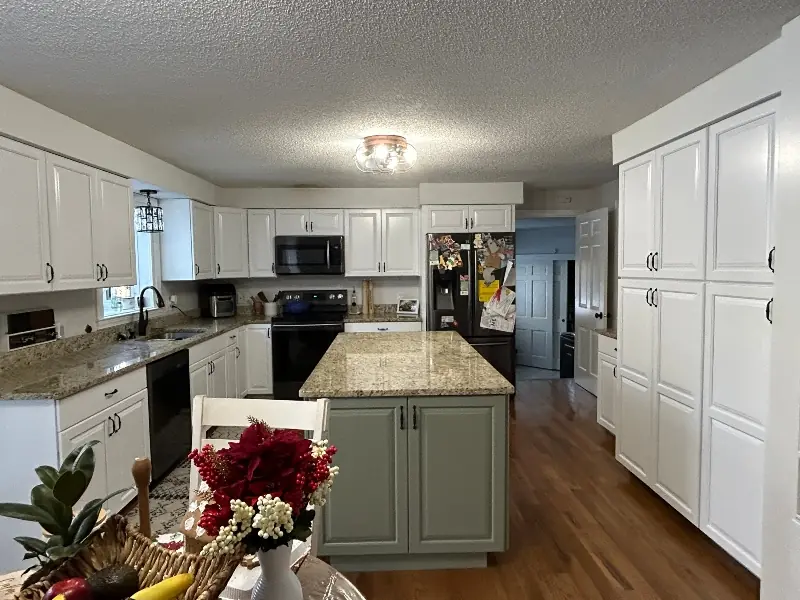
If you want a closer look at what happens each day, our post on what to expect when your cabinets are professionally painted covers it step by step, and how long cabinet painting lasts covers durability.
Two-tone with refacing instead of paint
Paint is the right tool when you like your door style and just want new color. If the doors themselves are the problem — dated raised panels, worn edges, a partial-overlay look you're tired of — cabinet refacing lets you change the style and go two-tone at the same time. New doors and drawer fronts are made to order in your chosen style and finish, so the uppers can come in one color and the lowers in another. It costs more than painting, but you end up with new doors rather than repainted old ones.
If you have oak cabinets and aren't sure which way to go, how to update oak cabinets lays out the options side by side.
Not sure which two colors? Text a few photos of your kitchen — counters, floors, and the room as a whole — and Raymond will tell you what he'd pair with them. Request a free estimate or call or text (413) 450-0028.
Frequently asked questions
How much do two-tone kitchen cabinets cost?
A typical two-tone cabinet painting project in Western and Central Massachusetts and northern Connecticut runs about $5,500–$11,000, compared with $4,900–$9,900 for single-color painting. Door count, a contrasting island, and oak grain (an additional $500–$1,500) are the main things that move the price.
Should the upper or lower cabinets be darker?
In almost every kitchen, the lower cabinets should be the darker color. Dark bases ground the room and hide scuffs at kick height, while light uppers keep the space open and bright. Dark uppers over light bases tend to make a kitchen feel top-heavy and smaller.
What are the most popular two-tone cabinet color combinations?
White or off-white uppers with navy, sage green, forest green, or charcoal lowers are the most requested. Warm cream uppers with a muted forest green are a close second. The right pairing depends on your countertops, floors, and how much natural light the kitchen gets.
Can the kitchen island be a different color?
Yes. A contrasting island is the most common form of two-tone, and it can also be a third color alongside a two-tone upper and lower split. It works best when the island color picks up an accent from the countertop or backsplash.
Will two-tone cabinets go out of style?
Specific colors come and go, but the idea of a lighter perimeter with a deeper base or island has been around for decades. And because a professionally painted cabinet can be repainted later, choosing two-tone today doesn't lock you in.