The short answer
Every cabinet hinge is either concealed (invisible with the door closed) or exposed (visible by design). It also has to match how the door sits on the cabinet — full overlay, partial overlay, or inset. Answer those two and the list of hinges that will work is short. Soft-close is a feature layered on top, not a fourth category.
Hinges are the least glamorous decision in a kitchen project and one of the few you feel every single day. A door that closes with a bang, a pair of uppers that no longer line up, a gap that's wider at the top than the bottom — those are all hinge stories.
They're also the hardware that quietly sets the whole look. The reason a 1995 kitchen reads as 1995 even after a repaint is usually that the doors sit inside the face frame openings with wide bands of frame showing between them. That's a hinge decision, not a door-style decision.
Concealed vs. exposed: the first fork in the road
Before any brand or model, you're choosing between two philosophies of what a hinge is for.
Both doors are closed. On the left the hardware has disappeared; on the right it's doing visual work. Neither is more correct — they belong to different kitchens.
Concealed hinges are the modern default. Everything mechanical lives behind the door, so the only thing your eye reads is the door face and the gap between doors. Nearly every kitchen built in the last thirty years uses them.
Exposed hinges put the hardware on display. They're the traditional approach — the way a piece of furniture is hinged — and they pair naturally with inset doors, farmhouse kitchens, and period work. They're a style statement, and they need to coordinate with your pulls and knobs.
The hinge types, one by one
The workhorse. A round cup is bored into the back of the door and an arm reaches to a plate mounted inside the cabinet. Invisible when closed, and adjustable in three directions after installation. This is what refaced cabinets get hung on here — Blum soft-close.
The same idea adapted for American framed cabinets, where the plate screws to the face frame rather than a cabinet side wall. Sometimes called compact or half-wrap hinges. Still hidden, still adjustable, sized for full or partial overlay.
A cup hinge geometry built for doors that sit flush inside the frame opening instead of on top of it. Keeps the clean, seamless face people want from inset without any hardware showing. More on the look in our inset cabinet doors guide.
Screwed to the outside of the face frame and the door, with the barrel and leaf visible. Traditional and furniture-like. Common on inset kitchens, and available in finishes meant to match your pulls and knobs.
Two flat leaves mortised into the door edge and the frame, so only the barrel shows. The oldest approach and the most furniture-like. Beautiful on the right cabinet, and unforgiving — the mortise has to be cut precisely, and it has little adjustment once set.
Corner cabinets, bi-fold doors, and lazy-Susan cabinets need hinges built for wider swing angles or pie-cut door pairs. Upward-opening doors use lift-up hardware instead of a conventional hinge.
Why the hinge decides overlay vs. inset
This is the part most hinge articles skip, and it's the reason the topic matters at all.
Your doors sit on your cabinets in one of three ways, and the hinge is what physically produces each one:
- Full overlay — doors nearly cover the face frame, with only narrow reveals between them. The frame all but disappears. This is the contemporary look, and it's what new doors are typically made to.
- Partial overlay — doors cover only part of the frame, leaving visible bands between every door. Standard on kitchens built before roughly 2010, and the single biggest reason an otherwise fine kitchen reads as dated.
- Inset — doors sit flush inside the frame opening, so the door face and the frame face are level. A premium, furniture-grade look, quoted separately because the tolerances are tighter.
You can't get from one to another by swapping doors alone. The hinge geometry has to change with it — which is why a refacing or door-replacement project is the moment this upgrade happens, and why it rarely happens at any other time.
The upgrade nobody asks for by name. Refacing typically converts a partial-overlay kitchen to full overlay. Homeowners almost never request it, and it's frequently the change they comment on first when the job is done. The full comparison lives in the cabinet door overlay guide.
Soft-close: a feature, not a type
Soft-close gets talked about as though it were its own category of hinge. It isn't. It's a damper — a small hydraulic cylinder that catches the door in the last inch or so of travel and eases it shut. It comes two ways:
- Integrated — the damper is built into the hinge body. Cleanest, most reliable, and what you want on a new installation.
- Clip-on / add-on — a separate damper that attaches to an existing hinge. Useful when you're keeping the hinges you have.
We retrofit soft-close hinges to existing doors as a standalone job, priced per door. It's among the least expensive things we do, and it's the upgrade customers mention first afterward. See storage & hardware upgrades for how that works on its own.
The efficient time to do it, though, is when the doors are already off for something else — refacing, refinishing, painting, or new doors. Every door gets handled once instead of twice.
A Blum soft-close European hinge — cup in the door, plate on the cabinet, damper built in. Invisible the moment the door closes.
What refacing includes →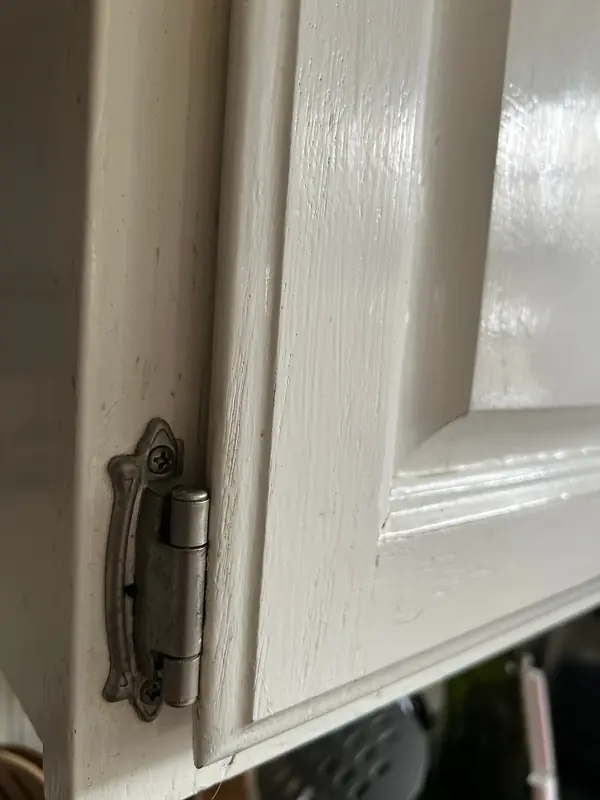
Exposed hinges on painted doors. Here the hardware is deliberate — it reads as furniture, and it has to coordinate with the pulls.
Inset cabinet doors →Quick comparison
| Hinge type | Where it's used | Visible when closed | Adjustable | Soft-close |
|---|---|---|---|---|
| Concealed European (cup) | Frameless cabinets; framed with adapter plates. Full or partial overlay. | No | Yes — three-way | Integrated or clip-on |
| Face-frame concealed | American framed cabinets, full or partial overlay | No | Yes | Integrated or clip-on |
| Concealed inset | Inset doors, flush face | No | Yes | Commonly available |
| Exposed / surface-mount | Inset and traditional kitchens; decorative | Yes — by design | Limited | Usually a separate damper |
| Butt hinge | Furniture-grade and period work | Barrel only | Minimal | Separate damper |
| Corner / specialty | Lazy-Susan, corner, and bi-fold doors | Varies | Varies | Varies by model |
The three adjustments that fix most door problems
If your doors are out of line, the odds are good that nothing is broken. Concealed European hinges are built to be tuned, and they drift over years of use, house settling, and New England humidity swings.
Three screws, one screwdriver. It's also why a professional install looks different from a DIY one — the doors go on, then every reveal gets walked and tuned.
When adjustment genuinely won't solve it, the hinge has usually run out of range, or the screws have stripped their holes in a particleboard cabinet, or the hinge itself is bent. At that point replacement is the fix — and it's usually the moment to go soft-close, since you're handling every door anyway.
Which one should you actually choose?
Not sure what you've got? Open a door, take a photo of the hinge, and send it over. Raymond can tell you what you're working with, whether it's adjustable, and what changes when you swap doors. Request a free consultation or call (413) 450-0028.
Frequently asked questions
What are the different types of cabinet hinges?
Cabinet hinges fall into two broad families. Concealed hinges are hidden entirely behind the closed door and include European cup hinges (the modern standard), face-frame concealed hinges for framed cabinets, and concealed inset hinges. Exposed hinges are visible by design and include surface-mount, butt, and decorative furniture-style hinges. There are also specialty hinges for corner and lazy-Susan cabinets, and lift-up hardware for upward-opening doors. Soft-close is a feature that can be built into most concealed hinges rather than a hinge type of its own.
What is a European cabinet hinge?
A European hinge — also called a cup hinge or concealed hinge — mounts into a round recess bored into the back of the door and attaches to a plate inside the cabinet. Nothing shows when the door is closed. Its main advantage is three-way adjustment: after installation the door can be moved up and down, in and out, and side to side with a screwdriver, which is how an installer gets every reveal on a run of cabinets to line up.
Do inset cabinets need special hinges?
Often, yes. Inset doors sit flush inside the face frame opening rather than on top of it, so they use either exposed decorative hinges for a traditional, furniture-like look, or concealed inset-specific hinges that keep the flush face clean. We'll help you choose the right hinge style during your consultation. How inset compares to the two overlay styles is covered in the cabinet door overlay guide.
Can you add soft-close hinges to existing cabinets?
Yes. Soft-close hinge retrofitting is one of the most cost-effective upgrades available and is priced per door. It's also the one customers mention first afterward. The most efficient time to do it is during a project when the doors are already off — refacing, refinishing, painting, or new door installation — because each door only gets handled once.
How do I tell what hinges my cabinets have?
Open a door and look at the inside edge. If you see a large round cup set into the back of the door with an arm running to a plate on the cabinet, you have concealed European hinges. If you see a small metal leaf screwed flat to the inside of the face frame, you likely have a face-frame concealed or semi-concealed hinge. If you can see a barrel or decorative plate on the outside with the door closed, they're exposed. Whether the door covers the frame or sits inside it is the other half of the answer.
Do new cabinet doors come with new hinges?
New door installation is the natural time to upgrade to soft-close hinges, and we strongly recommend it — the hinges are coming off anyway. Whether hinges are included or priced as an upgrade should be spelled out on your written quote. It's a common line item to leave out, so it's worth confirming on any quote you compare, as we note in our cabinet door replacement cost guide.
Why won't my cabinet doors line up?
Most misaligned doors are an adjustment problem, not a broken hinge. Concealed European hinges have three adjustment screws that move the door up and down, in and out, and side to side, and they drift over years of use, settling, and seasonal humidity. Worn or bent hinges on older cabinets can reach the end of their adjustment range — in which case replacement is the fix.
What hinges does Homestead Cabinet Design use?
Refaced cabinets are hung on Blum soft-close European hinges. If drawers are replaced, they're 5/8-inch solid maple boxes on Blum soft-close, full-extension undermount slides. For inset doors we use either concealed inset hinges or exposed decorative hinges, depending on the look you're after. Call (413) 450-0028 or request a free consultation to talk it through.